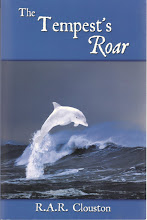
I am donating 100% of the royalties I receive on the next 5,000 copies (paperback or digital) that I sell of The Tempest's Roar, to organizations whose goal it is to save the whales and dolphins. And I would like to encourage you to buy my book to help in this cause: it is available at amazon.com, barnesandnoble.com, and other online booksellers in either paperback or digital versions (the Kindle and Nook versions are currently selling for $3.19).
Among those who have read it I think one reviewer said it best when he described it as Lord of the Rings meets Finding Nemo. To learn more about this story that blends scientific fact with speculative fiction and thereby appeals to both the head and the heart, please go to my website at www.rarclouston.com
Showing posts with label The Tempest's Roar. Show all posts
Showing posts with label The Tempest's Roar. Show all posts
Monday, May 9, 2011


Thursday, April 21, 2011
The Humpback Hit Parade
Building upon the musical theme of my previous posting, albeit on a happier note (pun intended), a study conducted by graduate students at the University of Queensland, and reported online in Current Biology, reveals that male Humpback Whales within a specific population all sing the same mating song at any given time. (Gosh, you'd think that at least one of these big boys would want to sing his own tune to stand out from the rest of the gang; but then again, perhaps female Humpbacks aren't too particular as long as their prospective mates can carry a tune, any tune.)
The researchers report that these "cultural waves" spread across the ocean as they are copied by whales in other populations, in what amounts to a Humpback hit parade. And just like with their human counterparts, when one song has gained ocean wide popularity a new song will appear to replace it.
As Pan, the little Harbor Porpoise, and co-star of my book, The Tempest's Roar, might say, "Pleases us. Pleases us," because to him, whalesong is the most beautiful sound any sentient being can hear on this tiny blue space marble that we call Earth but whales know as Planet Ocean.
The researchers report that these "cultural waves" spread across the ocean as they are copied by whales in other populations, in what amounts to a Humpback hit parade. And just like with their human counterparts, when one song has gained ocean wide popularity a new song will appear to replace it.
As Pan, the little Harbor Porpoise, and co-star of my book, The Tempest's Roar, might say, "Pleases us. Pleases us," because to him, whalesong is the most beautiful sound any sentient being can hear on this tiny blue space marble that we call Earth but whales know as Planet Ocean.
Subscribe to:
Posts (Atom)